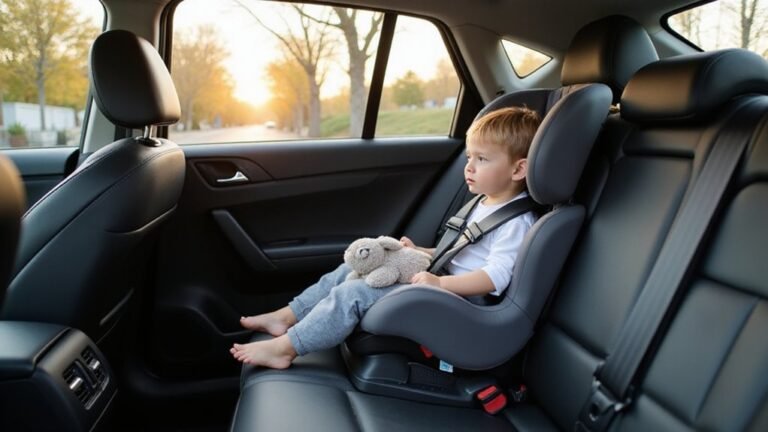


Wondering whether to keep your child rear-facing longer or switch to forward-facing? Experts say keeping them rear-facing as long as possible is safest.
It’s proven to be four times safer in crashes and greatly reduces serious injuries. In this article, you’ll learn why staying rear-facing matters and how to make the switch safely when the time comes.
Why Rear-Facing Car Seats Are Safer
Rear-facing car seats are safer because they cradle your child’s head, neck, and spine during a crash. The seat material absorbs and distributes crash forces across the entire shell, rather than concentrating them on fragile shoulders and necks. Proper installation tools, like a locking clip or tether strap, are essential to secure the seat tightly; any movement diminishes its protective “cradle” effect. In a frontal crash, your child presses into the seat back, keeping their head and spine aligned. This positioning prevents whiplash and reduces strain on a still-developing neck. The design distributes impact energy throughout the seat, lowering the risk of severe head or spinal injuries. Experts recommend keeping children rear-facing as long as their weight and height allow for maximum safety. For a secure fit, choosing a model with a perfect fit ensures the seat shell stays firmly in place. A critical advantage is that this positioning also protects the fragile spinal cord from dangerous stretching forces common in forward-facing impacts. To further support milk production while pumping, some parents find that frequent pumping sessions help maintain a consistent supply.
How Much Safer Rear-Facing Is in Crashes
Rear-facing seats offer significant safety advantages. They reduce your child’s risk of any injury by about 9% compared to forward-facing seats. The difference is even more pronounced for serious injuries—forward-facing seats nearly double the danger, with an odds ratio of 1.76. Swedish data shows a remarkable 92% decrease in serious injuries when children are kept rear-facing. In side-impact collisions, children are four times safer in rear-facing seats. This is because a rear-facing seat cradles your child and moves with them during a crash, dispersing crash forces across their entire back. Ensuring the seat fits your vehicle and that the harness is snug are crucial steps. Some of the top-rated changing pad covers offer secure fits and easy cleaning for the diaper area. Rear-facing seats cradle your child and move with them during a crash, dispersing crash forces across their entire back. This distribution of force is why forward-facing seats carry a five times higher risk of causing severe injury or death in small children. If you are also nursing, proper nipple cream care can help prevent discomfort during breastfeeding.
When to Switch From Rear-Facing to Forward-Facing
You should switch from rear-facing to forward-facing once your child reaches the maximum height or weight limits specified by your car seat manufacturer. Many seats allow children to stay rear-facing past age 2, sometimes until age 3 or 4. The common recommendation of age 2 is only a minimum, not an ideal age to switch. Keep your child rear-facing as long as possible, even if they exceed those age markers. Unlike a booster seat, which has clear age and weight signs for when to stop use, rear-facing seats rely on specific fit and manufacturer limits. Ensuring your pack n play is set up correctly, with no gaps around the mattress, similarly requires attention to manufacturer instructions for safety.
The key factor is your child’s height. Check that there is less than one inch of clearance above their head. When their head gets too close to the top of the seat shell, it’s time to switch to forward-facing, regardless of weight. Children with longer torsos may need to switch earlier due to their seated height. Before making the switch, ensure your child meets the minimum height and weight requirements listed by the forward-facing seat manual. Always verify the specific limits for your seat to ensure safety. For context, just as a crib mattress must fit snugly within the crib frame without gaps to prevent hazards, a car seat must fit your child’s body proportions correctly for maximum protection. Proper fit ensures the harness and seat shell work as designed in a crash.
Why Rear-Facing Protects the Head and Neck
Rear-facing car seats protect your child’s head and neck by acting as a protective cocoon during a crash. The seat cradles their head, neck, and spine together, distributing crash forces across the entire back rather than focusing them at restraint points. This orientation reduces the load on your child’s delicate neck by up to five times because the seat shell prevents their heavy head from pulling forward independently. Ensuring your rear-facing seat fits your vehicle properly is essential for maximum protection. Many top-rated newborn swings offer a similar reclined, supportive design to keep an infant comfortable and secure. When comparing safety features, look for models that include a 5-point harness to secure your child at the shoulders, hips, and between the legs. The seat keeps your child’s spine aligned and snugly positioned, allowing the car seat to absorb impact energy instead of your child’s body. For infants and toddlers under 23 months, biomechanical research shows that this orientation significantly lowers the risk of severe injury compared to forward-facing options. Similar to lowering the crib mattress at the right developmental milestone, this protective position is critical for your child’s safety during early growth.
What Happens in a Crash With a Forward-Facing Seat
In a frontal crash, your child’s body continues to move forward until the harness restrains the torso. However, the head, now unsupported by the seat shell, snaps forward, causing strain on the neck and spine as crash forces concentrate at the harness contact points instead of spreading across the seat’s surface. This whiplash-like motion generates dangerous neck loads and pushes the chest forward, significantly increasing the risk of head and spinal injuries. Britax car seats are designed with advanced safety features like energy-absorbing foam to mitigate these forces, but the fundamental physics of forward-facing travel remain unchanged. Using soft crib bedding in a nursery can create a separate suffocation hazard, but for car seats, the focus remains on crash force management.
In side impact collisions, your child can pivot toward the struck door or window, raising the chance of hitting hard structures. If an airbag deploys in the front seat, it adds another hazard because the unsupported head of a forward-facing child can be thrust into the deploying bag. Crash-test data shows that children in forward-facing seats face about five times the risk of serious injury compared to rear-facing seats, since the forces focus on the neck rather than being spread evenly across the seat shell. For most families, choosing an all-in-one car seat can provide extended rear-facing options that better manage these crash forces.
Signs Your Child Has Outgrown the Rear-Facing Seat
Your child has outgrown their rear-facing seat if any of these signs appear: First, check the head clearance. If there is less than one inch of space between the top of their head and the seat shell, they have reached the height limit. Next, look at the harness straps; they should sit at or below their shoulders. If their shoulders are above the top slots, the seat is too small. Also, verify the seat label and manual for specific weight and height limits—don’t estimate. Pay attention to the padding: if it shifts or you can’t get a snug, secure fit, it indicates your child has outgrown the seat. Lastly, ensure the seatbelt fits properly when installing the seat. A poor fit may mean the seat no longer suits your child’s size. When any of these signs are present, it is time to switch to a larger seat. For sleep safety, ensure the seat’s padding does not create a soft surface that could compromise a secure fit, similar to how firm crib mattresses prevent suffocation risks. If you experience difficulty adjusting the seat’s recline or harness tension, check for a stuck folding mechanism common in jogging strollers that may require troubleshooting. For those organizing a child’s room, storing the outgrown seat requires a chest of drawers with sufficient drawer height to hold bulky harness components.
How to Choose a Convertible Seat That Lasts Longer
To ensure your child can use a convertible seat for the longest possible time, focus on models with higher rear-facing weight limits—ideally up to 40-50 pounds. This allows you to keep your child rear-facing longer, which is safer for their developing neck and spine. When choosing the seat, check that it fits your child’s height and size within the harness limits, providing enough headroom and legroom so they don’t outgrow it prematurely. However, you should also weigh the everyday use of a booster seat, which may offer more legroom and easier buckling for older toddlers, against the safety benefits of extended rear-facing. Test the seat in your vehicle to confirm a secure fit, aiming for less than one inch of movement at the belt path. A proper fit prevents compatibility issues and extends the usable life of the seat. Additionally, opt for straightforward features such as an adjustable harness that can grow with your child, avoiding models with overly complex mechanisms that may break or become difficult to use over time. Simpler designs tend to last longer daily, ensuring your child remains safely rear-facing for as many years as possible. When comparing options, consider how the seat’s recline and padding compare to the best strollers for newborns to ensure your infant remains comfortable on longer trips.
3 Installation Mistakes That Reduce Crash Protection
Proper installation is essential for maximum crash protection. A common mistake is a loose seat, which allows dangerous movement during a crash. You should check that the seat moves no more than one inch at the belt path; anything more reduces its effectiveness. Another mistake is using the wrong recline angle. For rear-facing seats, keep the seat at an angle between 30 and 45 degrees from vertical. The National Highway Traffic Safety Administration has found that over 30% of installations are off this mark. Finally, avoid combining the seat belt and LATCH system unless the manual explicitly says it’s okay. Using both together can compromise the seat’s stability. Correctly installing the seat by avoiding these errors significantly enhances your child’s safety during an accident.
Why the Back Seat Is the Safest Spot
The back seat, especially the rear center position, is the safest spot in the car for your child. This location keeps your child farther from airbags and side impacts, reducing the risk of injury. The center seat offers the best protection because it is the furthest from door impacts and side airbags. However, seat comfort and vehicle compatibility are important factors to consider. If your car’s center seat lacks a proper three-point seat belt or ISOFIX anchors, you cannot install the car seat there safely. In that case, the next safest option is a rear outboard seat. As long as you secure the seat tightly, you’re not sacrificing much protection. Keep in mind that the front passenger seat carries a higher risk because airbags deploy even at low speeds and can strike your child’s head. For maximum safety, always prioritize the back seat when choosing where to place your child’s car seat.
How Long Should You Keep Your Child Rear-Facing?
Keep your child rear-facing until they reach the maximum height or weight limit of their car seat. This position is the safest for their head, neck, and spine, and many children can stay rear-facing until age 3 or 4 with convertible seats. Do not turn them forward early for comfort or because their legs bend. Turning them before outgrowing the seat’s limits compromises safety, not their convenience. Always check your seat’s manual for specific height and weight limits and follow the 1-inch shell rule above their head to ensure proper fit.