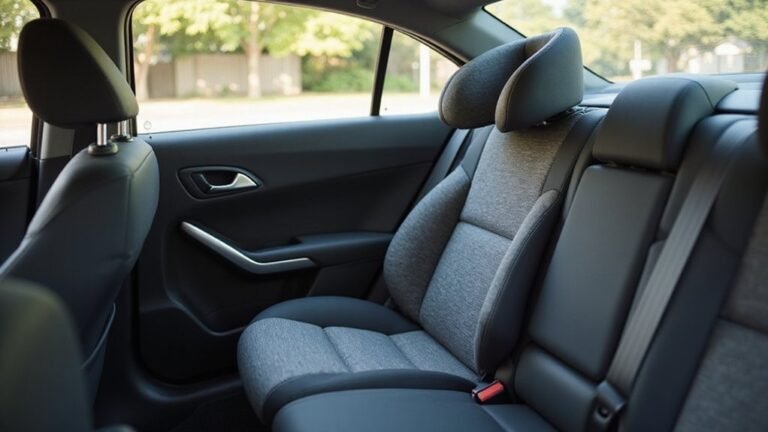

Wondering why keeping your child in a rear-facing car seat is so important? It might be the safest way to protect their delicate head, neck, and spine during a crash.
By cradling these vulnerable areas, rear-facing seats can significantly reduce the risk of injury, especially in front-end collisions. Keep reading to find out exactly why this position offers the best safety for your little one.
Why Rear-Facing Seats Protect a Child’s Neck and Spine Best
Because a young child’s head is proportionally much larger and heavier than an adult’s—making up about 25% of their body weight compared to just 6%—and their neck muscles and spine are still developing, a rear-facing seat provides optimal protection. It cradles the entire head, neck, and torso together, aligning with your child’s anatomy. This design helps prevent abrupt forward motions that can cause strain or injury to fragile neck structures during a crash. The seat’s shell supports the back and preserves spinal alignment, reducing abnormal bending forces. Safety guidelines from the AAP recommend keeping your child rear-facing until they exceed the seat’s height or weight limits. Using this position can significantly lower the risk of serious injury—studies show over an 80% reduction in head-on crash injuries—because it directly addresses the vulnerability inherent in your child’s developing body. Selecting a top rated crib mattress that offers firm, flat support can further safeguard your child’s spinal alignment during sleep. To maximize this protection, the rear-facing car seat effectively distributes crash forces across the stronger back and shoulders, as detailed in crash test data from leading safety organizations. Using a car seat protector underneath the seat can help keep your vehicle’s upholstery clean and free from indentations without compromising safety.
How Rear-Facing Spreads Crash Forces More Evenly
Turning your child’s car seat to face the rear allows the shell to distribute crash forces more evenly across their entire back, neck, and pelvis. Instead of concentrating impact energy at narrow harness points, the large surface area of the seat absorbs and spreads the forces. When your child slides into the seat back, the shell cradles their body and acts as a cushion against impact. This design helps to reduce peak stress on specific body regions. The combined work of the harness and shell means that the straps are not bearing all the force, as the shell absorbs much of the crash energy. Additionally, because the seat moves with the vehicle seat during a collision, it decelerates your child more gradually, further diffusing crash forces along the shell rather than funneling them into small restraint points. For parents focused on long-term comfort and durability, finding a seat with a custom fit cover that matches the shell’s contours can also enhance how evenly those forces are managed. For a similar focus on comfort and fit, many parents also consult reviews of top booster seats when their child outgrows rear-facing limits.
What the Research Says About Rear-Facing Safety and Injury Reduction
Research shows that rear-facing car seats significantly reduce injury risk. They are proven to lower the chances of injury by about 9% to 14% compared to forward-facing seats. For children under the age of two, using a rear-facing seat makes serious injuries 1.76 times less likely. The effectiveness of rear-facing seats reaches 93%, which is notably higher than the 78% effectiveness of forward-facing seats. When selecting a seat, finding the perfect fitted sheet for comfort and support is also important for overall safety. This seat position cradles your child’s entire torso, neck, and head, moving with them during a crash. This movement helps reduce stress on the spine and minimizes injury. Additionally, rear-facing seats offer increased comfort by keeping the head, neck, and torso aligned and supported during impact. Choosing a top high chair ensures similar protection through quality and value in feeding setups. The evidence is clear: until your child outgrows the seat’s height or weight limits, rear-facing provides the best protection. To maintain that protection, you must avoid common installation mistakes, such as a loose base, which can compromise the seat’s stability and safety. Confirming a tight base fit is essential, as a properly secured base ensures the seat performs as designed during a crash.
How Rear-Facing Handles the Most Dangerous Crash Type: Frontal Impacts
Rear-facing seats are uniquely designed to better handle frontal impacts. During a head-on crash, your child’s body tends to move forward, but the seat’s shell absorbs much of the force first. Instead of the energy concentrating on the neck and head, it is distributed across the entire back of the seat. This design keeps your child’s head, neck, and spine moving together, reducing the risk of dangerous relative motion between these areas. Research indicates that at 50 km/h, the load on a child’s neck decreases from as much as 300 kg to around 40 to 60 kg when using a rear-facing seat. This significant reduction demonstrates why rear-facing seats provide substantially better protection in frontal impacts. For families seeking maximum safety, many top picks also include sturdy base designs that further secure the seat and absorb crash forces. Many of these recommended seats also use energy-absorbing shells that help manage crash forces more effectively across the full seat structure. A travel system often pairs these seats with a compatible stroller for convenient everyday use.
Why Age and Development Make Rear-Facing the Right Choice for Longer
Staying rear-facing beyond infancy is the safest choice because a child’s body is still developing and more vulnerable during early years. A child’s head can be about 25% of their total body weight—much heavier than an adult’s 6%—and their spine has shallow vertebrae and loose ligaments. Rear-facing seats support the entire back, distributing crash forces evenly, which reduces stress on the head, neck, and spine. This position keeps everything aligned during a collision, offering better protection for the central nervous system and overall body. As children grow, their skeletons and muscles develop, but remaining rear-facing until they exceed the seat’s height or weight limits continues to provide optimal safety. For storing essential baby gear like extra diapers and blankets, choosing a chest with multiple drawers can help keep the nursery organized and clutter-free. Swedish data shows that children who ride rear-facing until age four experience extremely rare injuries, highlighting the importance of keeping them rear-facing as long as possible. For additional peace of mind while your child is riding safely, choosing top crib bedding sets that meet strict safety standards can help create a secure sleep environment.
Load Legs and Anti-Rebound Bars: Maximizing Rear-Facing Protection
Load legs and anti-rebound bars significantly enhance rear-facing protection by reducing dangerous movement during a crash. A load leg provides a third contact point with your vehicle’s floor, which decreases forward pitch and helps keep your child more upright. This added stability can cut the risk of head injury by up to 43% by limiting seat rotation and ramping during impact. An anti-rebound bar prevents the seat from snapping backward after the initial collision, keeping your child farther from the vehicle interior during rebound. This reduces the chance of head contact with interior surfaces. Although neither feature replaces correct installation, combining them maximizes crash performance and offers a safer, more stable ride during critical moments.