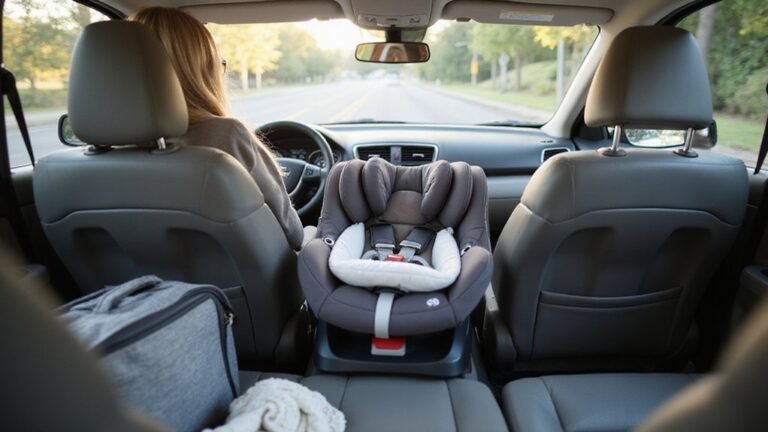


Wondering how to keep your child safer during car rides? A rear-facing car seat is designed to protect your little one in case of a crash by facing the back of the vehicle. It’s the safest position for young children, reducing injury risk significantly.
Keep reading to learn how to properly install and use one to maximize safety every time you hit the road.
What Is a Rear-Facing Car Seat and How Does It Work?
A rear-facing car seat works by positioning your child facing the back of your vehicle, acting like a protective cradle during a crash. It distributes impact forces across the head, neck, and spine, which are the most vulnerable areas for young children. Because the entire seat moves with your child, it helps contain them safely and minimizes the risk of injury. Unlike some other baby products, such as electric breast pumps for moms, this seat does not require a power source to function. For maximum protection, always keep your child rear-facing until they reach the seat’s maximum height or weight limit.
There are three main types of rear-facing seats: rear-facing-only, convertible, and all-in-one models. Convertible seats start in rear-facing mode and can later be switched to forward-facing as your child grows. Modern seats support your child’s neck and head far better than older or traditional designs, countering safety myths that suggest otherwise. Proper installation is essential; avoid relying on generic accessories to fix a loose fit. Instead, always consult your seat’s manual. It’s best to install the seat in the back row, preferably in the center using a three-point seat belt. The harness keeps your child’s body aligned, while the shell absorbs crash energy, providing critical protection until your child reaches the seat’s maximum weight or height limits, not just a certain age. For a perfect fit, consider reading best car seat cover reviews to ensure compatibility with your vehicle.
Why Rear-Facing Is the Safest Position for Your Child’s First Years
Because your child’s head is proportionally larger and their neck muscles are much weaker than an adult’s, rear-facing seats provide vital protection during a crash. In a front collision—the most common type—the entire body is cradled by the seat, spreading impact forces over a larger area. This makes seat design essential: the shell keeps the head, neck, and spine aligned, preventing forward flung movement. High-quality materials such as energy-absorbing foam further reduce the force transferred to your child, enhancing safety. Research shows that keeping your child rear-facing until they outgrow the seat’s height or weight limits can reduce the risk of death or serious injury by up to 75% for children under two. It’s not just following guidelines; it’s giving your child their best biomechanical protection during those critical early years. This 75% reduction in risk underscores why adhering to those limits is so crucial. This protective approach mirrors the principle of choosing products with the longest lifespan, where durability and sustained performance outweigh short-term convenience. Choosing the safest option for your child’s car seat mirrors the choice between breast pump and breastfeeding for infant nutrition, where optimal protection and long-term benefits outweigh the short-term appeal of convenience.
Infant-Only vs. Convertible vs. All-in-One: Which Rear-Facing Seat Fits Your Family?
A convertible seat is usually your best choice if you want your child to ride rear-facing for as long as possible. These seats stay installed in your car and typically have higher rear-facing weight limits, often up to 40 pounds or more. They offer thicker padding and a more durable harness adjustment system, which contributes to increased comfort and safety as your child grows. However, they tend to be heavier and less portable, making them less ideal for quick trips or frequent transfers between vehicles. If your priority is extended rear-facing use and a long-lasting seat that stays securely in your car, a convertible seat strikes the right balance. When choosing any child travel product, consider how the seat’s portability compares to the jogging stroller’s daily handling and storage requirements. For mealtimes at home, a dedicated model with a padded seat and removable tray provides the best comfort and convenience for feeding.
When Should Your Child Ride Rear-Facing? Age and Weight Guidelines
You should keep your child rear-facing until they reach the seat’s maximum height or weight limit, not just until a certain age. Legally, you must keep your infant rear-facing until at least age 1. However, many experts recommend continuing rear-facing past age 1—preferably until your child is 2 or even 3 or 4 years old—if they still fit within the seat’s limits. The American Academy of Pediatrics advises maximizing rear-facing safety until your child outgrows the seat’s specifications, rather than stopping at an arbitrary age. Many convertible car seats are designed to fit larger toddlers well beyond age 2. Remember, state laws only specify minimum requirements and do not necessarily reflect best practice. It’s crucial to keep your child rear-facing in the back seat, especially since airbags in the front can be dangerous or fatal for a forward-facing child. The best protection for your child is to retain the rear-facing position until your seat indicates it is no longer appropriate.
How Heavy and Tall Can Your Child Be to Keep Riding Rear-Facing?
Your child can remain rear-facing as long as they stay within the specific weight and height limits set by your car seat model. Typically, convertible seats allow children to ride rear-facing up to 40 or 50 pounds, but you must check the label or manual for your exact seat. Height limits are equally important. Most seats require your child’s head to stay at least 1 inch below the top of the shell or headrest. Some models cap standing height at 43 inches, while others go up to 49 inches. Remember, you cannot rely on weight alone; if your child surpasses the height limit even while under the weight maximum, they must switch to a forward-facing seat. Always follow the smaller of the two limits—either weight or height—and verify your seat’s specific numbers to ensure safety. Adhering to these limits is critical because car seat lifespan can also affect structural integrity over time. For comparison, selecting a top crib bedding set requires checking the specific weight and height capacities for each compartment to ensure proper fit.
What’s the Correct Recline Angle for a Rear-Facing Car Seat?
The correct recline angle for a rear-facing car seat is typically between 30 and 45 degrees from vertical. Newborns require a more reclined position, close to 45 degrees, to keep their airway open and support their weak neck muscles. As your child grows and gains head control, you can gradually adjust the seat to a more upright position, around 30 degrees, if allowed by the manufacturer. Always use your seat’s built-in level indicator on a flat surface to verify the angle before installation. Proper adjustment ensures your child’s head and neck are supported during sudden stops and minimizes the risk of their head falling forward or slipping out of the seat during a crash. Adjusting the base beforehand makes installation easier and helps maintain the correct recline angle during travel. For additional guidance, review top picks on quality and performance to ensure your chosen seat meets rigorous safety standards. A supportive bouncer seat can provide a safely reclined position for supervised awake time that complements proper car seat angle. Understanding correct crib mattress dimensions is also crucial for ensuring a snug fit in the crib, which prevents gaps that could pose a suffocation hazard.
Top 5 Rear-Facing Installation Errors to Avoid
The top five rear-facing installation errors can significantly compromise your child’s safety during a crash. To avoid these pitfalls, ensure you perform a tight installation where the seat does not move more than one inch at the belt path. Loosened or improper attachment is the most common mistake, occurring in up to 85 percent of cases.
Next, verify the correct recline angle by following the manufacturer’s indicator for a 30–45 degree tilt. An incorrect angle can affect the seat’s ability to absorb crash forces properly.
Always double-check harness adjustments. The harness slots should be at or below your child’s shoulders, with straps flat and snug enough that webbing does not pinch or twist. Additionally, position the chest clip at armpit level; improper placement occurs in about 60 percent of installations and can reduce effectiveness.
Finally, use the rear-facing belt path as instructed. Never attach straps to tethers unless specified in the manual, and lock lower anchors securely to prevent any slack. By avoiding these common errors, you’ll ensure your child’s car seat remains crash-ready and effective.
Why Pediatricians Say Keep Your Child Rear-Facing Until Age 4
Pediatricians recommend keeping your child rear-facing until at least age 4 because it significantly enhances safety. During a crash, a rear-facing seat cradles your child’s entire body, distributing crash forces across the back rather than concentrating them on the neck and head. This position helps protect the large head, which is proportionally bigger in young children, and supports the weak neck and spine while they are still developing. The seat’s shell absorbs impact energy, aligning the head, neck, and torso, which reduces the risk of whiplash and serious injuries. While car seat laws often specify minimum ages, they may not reflect the safest practice. Following pediatric guidance allows you to keep your child rear-facing up to the maximum weight or height limit of the seat, offering the highest level of crash protection during those critical early years. Research shows that rear-facing seats reduce the risk of severe injury by up to 82% compared to forward-facing seats. Just as a breast pump distributes suction evenly for comfort, this seat distributes crash forces across the body to protect your child. A pack n play provides a similar safety-focused containment for sleep or play, with an emphasis on secure, sturdy construction to protect infants in daily use.
Signs Your Child Is Completely Ready for Forward-Facing
Your child is ready to move forward-facing only when they have outgrown the rear-facing limits specified in your car seat manual. This usually means their weight exceeds 40 to 50 pounds or their height surpasses 43 to 49 inches. Check whether their head sits within one inch of the top of the car seat shell; if so, they’ve reached the maximum height. Don’t rush this transition for the sake of convenience—bent legs are not a valid reason to switch. For comparison, a glider recliner operates with a smooth back-and-forth motion, helping you maintain comfort during long feeding sessions while your child remains safely rear-facing.
Physical readiness is equally important. Your child must sit upright unassisted with steady head control and maintain proper posture throughout the ride. The harness fit is critical: it should be snug with no slack, and the chest clip positioned at armpit level. If you cannot achieve a proper fit, continued rear-facing use remains the safer choice.
Switch only when your child exceeds these limits and maintains correct posture. Avoid using car seat accessories that interfere with proper harness fit, as correct positioning always takes precedence over additional devices.
Step-By-Step: Switching From Rear-Facing to Forward-Facing Safely
To switch from rear-facing to forward-facing, start by reviewing both your car seat and vehicle manuals for forward-facing limits, belt paths, harness heights, recline settings, and tether anchor locations. Completely uninstall the seat from your vehicle. Adjust the recline to a more upright position suited for forward-facing use. Move the harness slots so they are at or above your child’s shoulders to ensure proper fit.
Reinstall the seat using the forward-facing belt path, which may involve the vehicle seat belt or lower anchors, depending on your seat’s design. Check the weight limits specified in the manuals to decide which method to use. Tighten the installation so that there is less than 1 inch of movement at the belt path, ensuring the seat is securely anchored. The American Academy of Pediatrics recommends rear-facing until at least age 2, but rear-facing is five times safer for reducing head, neck, and spine injuries. For families concerned about long-term use, twin mattress dimensions offer a more permanent sleep surface as children grow beyond infant car seats. As with other childcare routines, combining pumping and breastfeeding can help manage feeding schedules more flexibly.
Perform a seat belt adjustment by locking the belt or using the seat’s built-in lock-off to prevent slack. Always attach the top tether strap and remove any slack in the tether to reduce movement and improve stability. Secure your child in the seat, making sure the harness straps are at or above shoulder level. Tighten the harness until you cannot pinch any webbing at the shoulder point, providing a snug fit.
Position the chest clip at armpit level to keep the harness properly positioned on your child. Conduct a final stability check by gently rocking the seat—it should move less than 1 inch from side to side or front to back. These steps ensure your child’s safety during the transition from rear-facing to forward-facing.